Wednesday, August 8, 2018

California History Lesson 24 (Transcontinental Railroad)

California History
Transcontinental Railroad
Lesson 24


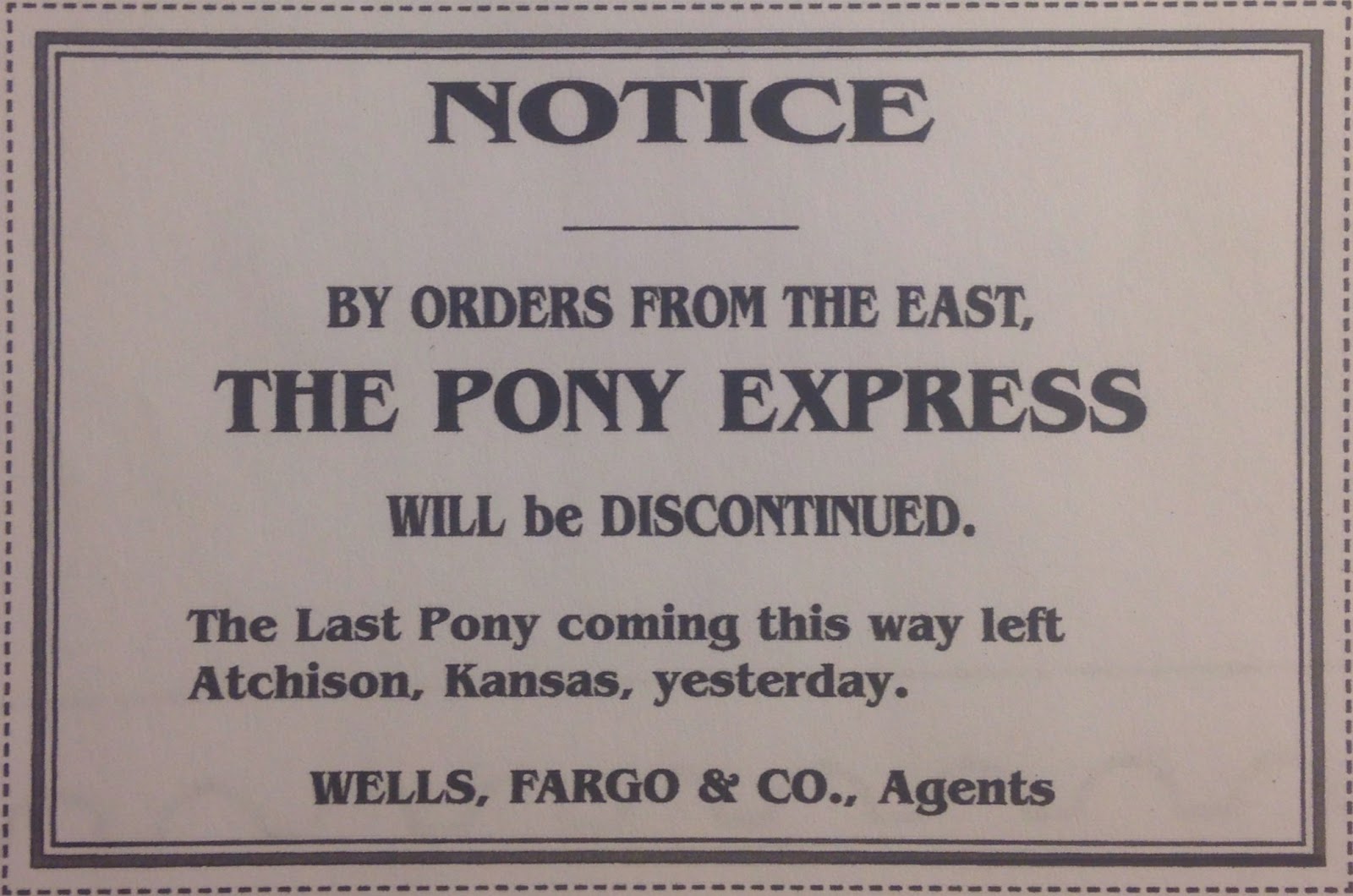
The Pony Express was no longer needed after the invention of the telegraph. The transcontinental line was completed on October 24, 1861. Transcontinental means “across the continent”. Messages could be sent by Morse Code in a manner of minutes.

In 1848 an attempt was made to develop a steamship line which would carry mail from Panama to California through the Isthmus of Panama. There was difficulty crossing Panama to the Pacific. Carriers had to travel primitive trails, go upstream in long canoes, endure mosquitoes, bad water and disease. A railroad was needed. In 1850, work began on a railroad across South America. It took 5 years of hard work. This was the first transcontinental railroad in the Western Hemisphere.

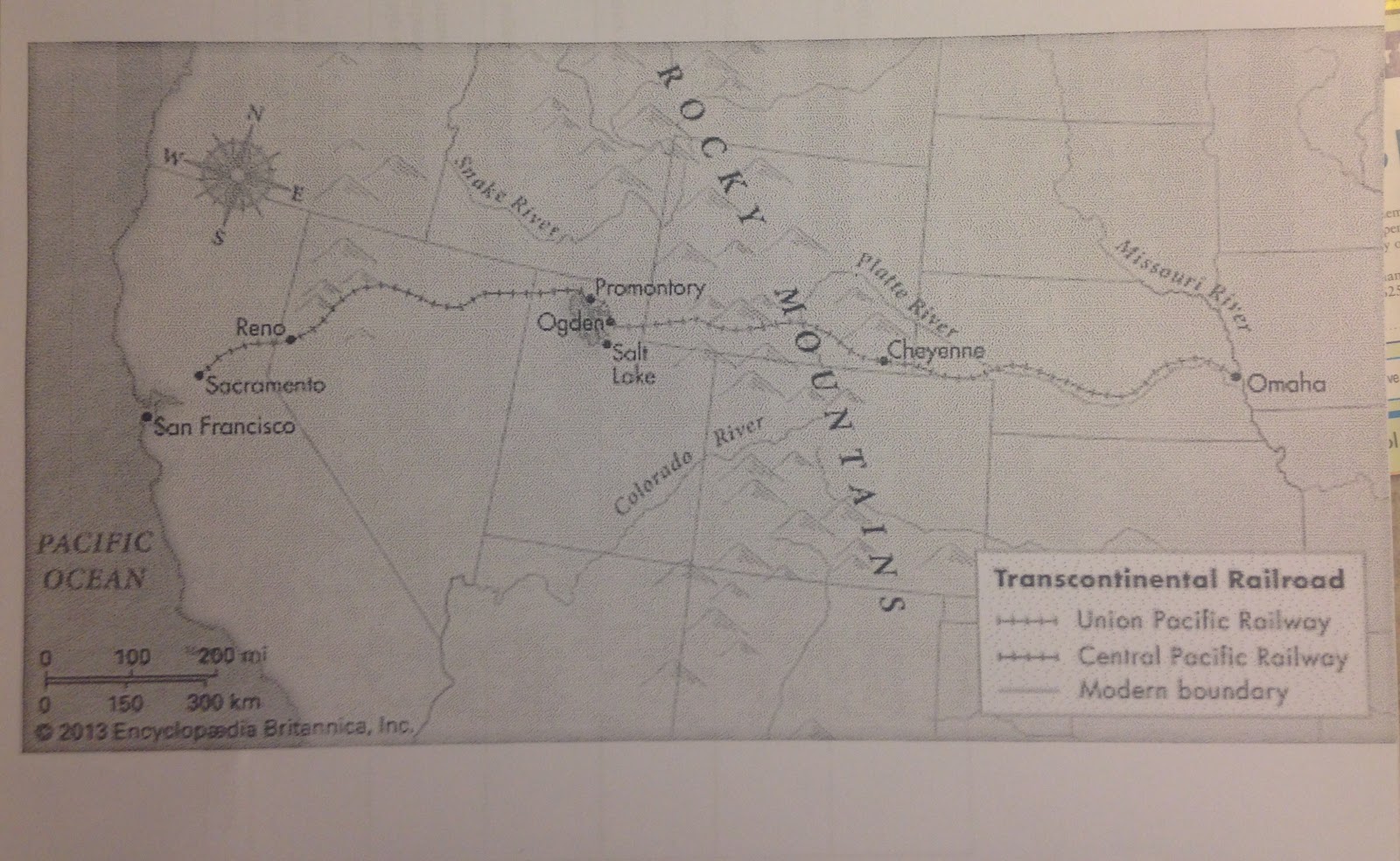
Californians desired to have a railroad that crossed the continent. It would take large amounts of money and lots of work. In 1862 when the south seceded from the Union, Congress passed the Pacific Railroad Act. Four wealthy men formed the Central Pacific Railroad Company. They became known as the Big Four. The Pacific Railroad Act named the Central Pacific and the Union Pacific Railroad Companies to build the railway. The Central Pacific Railroad was to build east from Sacramento. The Union Pacific Railroad was to build west from Omaha, Nebraska. Work began in 1863 in Sacramento. The Union Pacific began its work in the summer of 1865. Many Chinese men were hired to work on the railroad because they would work for low wages. The work was hard and dangerous. The summit of the Sierra was reached in 1867. Track was laid at the rate of between two and six miles a day by each company. Competition between the railroad companies increased the closer they got to one another. After seven years, in May of 1869, the two lines met at Promontory Point in Utah. They laid a total of 2,221 miles of track. People could travel from the Atlantic states to California in just five days. California was now linked with the eastern United States.

1) Chart showing number of days it took to travel each route.
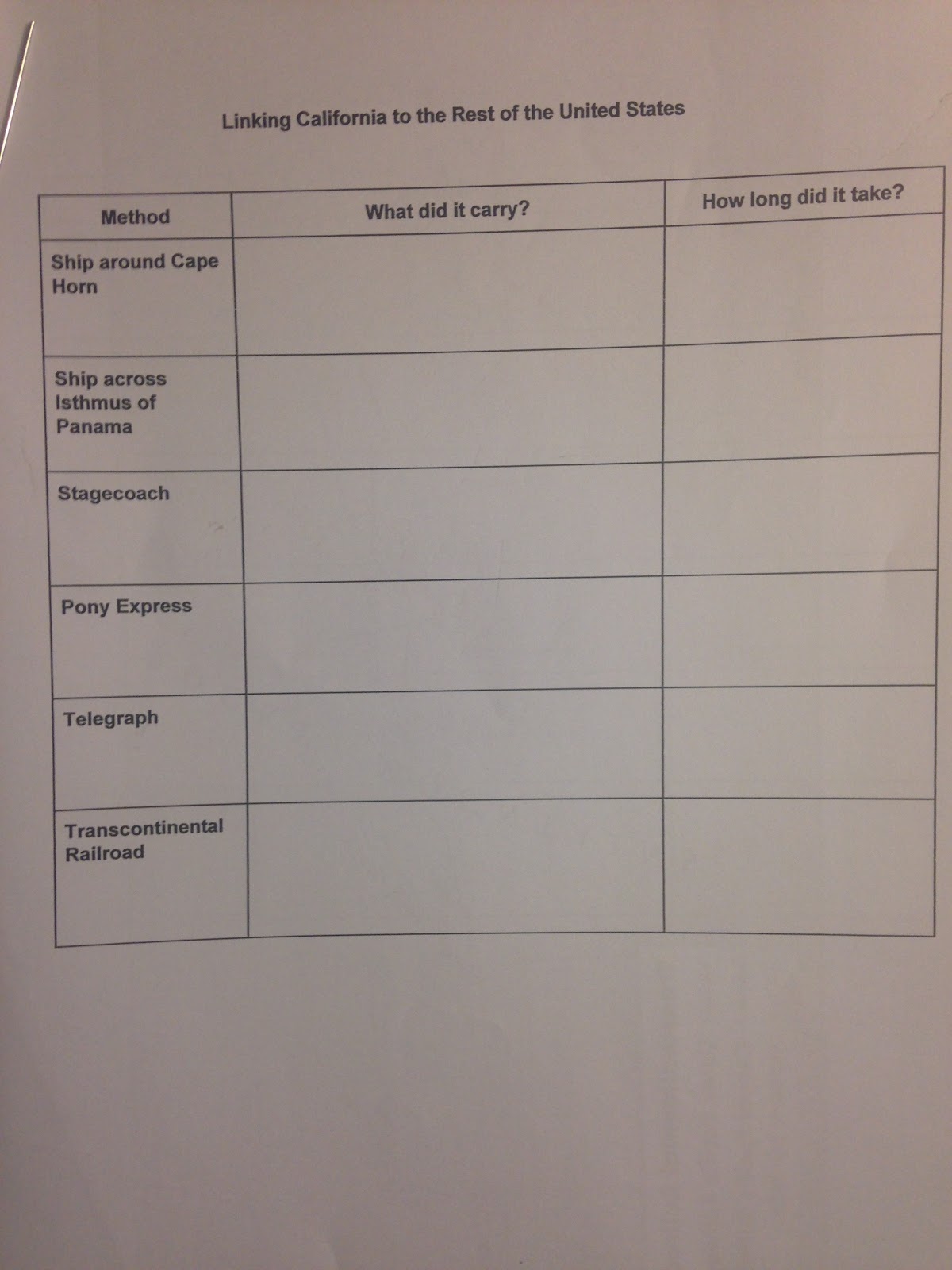


2) Map showing the Transcontinental Railroad. Trace each route with a different color.


3) Candy train

Link

California History Lesson 23 (Pony Express)

California History
Pony Express
Lesson 23


Sea travel played an important part of California’s history. Ships carried on the fur, hide and tallow and otter trade. During the Gold Rush, many people wanting to travel to California came by ship from New York to San Francisco. They either sailed around Cape Horn at the tip of South America or across the Isthmus of Panama in Central America. Traveling around Cape Horn took 6-8 months. Traveling through the Isthmus of Panama took 2-3 months.

Soon stagecoach companies formed. The first large stagecoach company was Adams and Company. They carried mail, gold and cash from the Sierras to New England. Their rival was Wells Fargo. It worked with the Pacific Mail Steamship Company and could handle goods sent to the Atlantic states via the Isthmus of Panama. Its lines covered every part of the state. In 1857, John Butterfield set up a stage route with way stations where travelers could eat and horses could be exchanged. Travelers could go from St. Louis, Missouri to San Francisco, California in 3-5 months. The stagecoaches also carried mail and goods. During the War Between the States, when the nation was divided, the Butterfield stage line ended.

People desired mail to get from one place to another more quickly. The Pony Express was created by William H. Russell in 1860 for this purpose. This mail system went from Saint Louis to Sacramento which was a distance of 1,980 miles. There were 200 stations, 500 horses and 80 riders. Riders would only spend two minutes at each station transferring the mail pouch and saddle to a fresh horse. Riders could travel the distance in just 10 days. It cost $5 for each ½ ounce to send a letter across the continent. Later the price dropped to $1.

Activities

1) Pony Express Timeline

1.William H. Russell, Alexander Majors, and William B. Waddell introduced the Pony Express as a way to deliver mail from St. Joseph, Missouri, to Sacramento, California. They promised delivery in 10 days at a cost of $5 per half ounce.

2. They secured about 420 high-grade ponies and about 80 male riders. Russell and his men also hired 400 station men and women. One hundred and ninety stations were opened 15-25 miles apart.

3. The riders would race at a top speed of about 10 miles per hour from one “relay station” to the next where they would make two-minute switches to fresh horses and continue on. Specifically designed mail-filled saddlebags called mochilas were easily transferred from one horse to another.

4. The first riders departed on April 3, 1860. Though the trips were rough, the mail arrived ten days later and great celebrations took place.

5. The most famous Pony Express rider was William F. Cody, better known as Buffalo Bill. He made one 384-mile trip without stopping for a sleep break!

6. Rider Bob Haslam, known as “Pony Bob,” pushed his speed to an incredible 15 miles per hour, doing his part to deliver President Abraham Lincoln’s inaugural address to California. The whole trip was made in seven days and 17 hours.

7. In November of 1861, the Pony Express made its final delivery. In a total of 308 runs, riders had traveled 616,000 miles and delivered 34,753 pieces of mail. The entire time, only one mochila was lost.

Used pictures from an activity in U.S. History Little Books Famous Events, Teacher Created Materials, Inc.


2) Design a stamp
Link


or Watercolor horse silhouette
Link

California History Lesson 22 (Statehood)

California History
Statehood
Lesson 22


The first inhabitants of California were the Native Americans. Then the Spaniards came who set up missions and presidios. Mexico got tired of the lack of support they received from Spain, so they went to war and won their independence. California was then owned by Mexico. Ranchos replaced the missions. The United States became interested in California as more and more people began to move west. The United States went to war with Mexico. For the sum of fifteen million dollars, the United States took possession of California, Texas and all the land in between.

The Gold Rush brought many people to California. It was hard to govern so many people. Representatives from every part of California were called together to write a constitution. A constitution is a set of laws for people to live by. Forty-eight delegates me on September 1, 1849. The delegation decided they wanted California to be a state, that no slavery would be allowed in California, white and Native American males were given the right to vote, and the boundaries they agreed on are the boundaries we have today. Once this constitution was approved by the voters, it was sent to Washington D.C. and presented to Congress. On September 9, 1850, President Zachary Taylor signed the bill for the admission of California to the United States, making California the 31st state.

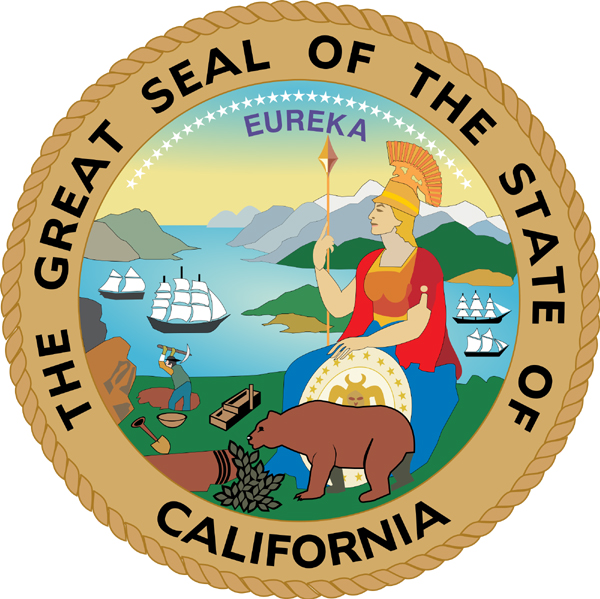
Each state has a seal to represent it. California’s seal was adopted at the Constitutional Convention of 1849. Each symbol on the state represents a part of California’s history.

Image result for california state seal

1) The 31 stars represent the number of states in the Union at that time.

2) Eureka means “I found it!” as a reminder of the gold found in the state.

3) The peaks of the Sierra Nevada stand for the grandeur of the nature.

4) Ships on the Sacramento River stand for the commerce (buying and selling goods) of the state

5) A miner laboring with a pick, rocker and pan represents industry (making goods from raw materials).

6) Agricultural wealth is seen in a sheaf of wheat and a cluster of grapes.

7) The armored figure of Minerva, the goddess of arts, sciences, wisdom and war in ancient Greek mythology keeps watch over the state.

8) According to myth, Minerva was born full-grown, just as California came into the Union without having first been a territory.

9) At her feet a grizzly bear symbolizes the state of California.

Activities 

1) California Seal - match meanings with symbols

2) Fill in map of California

California
Link


3) Dot to Dot
Connect the Dots Mystery Map
Link


4) Timeline Movie: 1) Native Americans 2) Missions 3) Ranchos 4) Pioneers 5) Bear Flag Revolt 6) Gold Rush 7) Statehood

Link


Monday, August 6, 2018

California History Lesson 21 (Gold Rush)

California History
Gold Rush
Lesson 21

Activities:

1. "Maps Tell the Story of the Mother Lode"


2. "As Good As Gold" Crossword

Created on TheTeachersCorner.net Crossword Maker


3. Gold Rush Word search

Link

4. Pop-up Miner picture
Panning for Gold lesson plan
Link


California History Lesson 20 (Gold Rush)

California History
Gold Rush
Lesson 20


The Gold Rush


Gold was discovered in California just 90 days before the end of the war with Mexico. The discovery of gold brought a lot of attention to California. John Sutter was the man who took care of all the immigrants coming into California. He needed lumber to build items to help the travelers. John Marshall was hired to find a place for a sawmill. He found a good place on the American River. It was there that he first found gold. They tried to keep it a secret because John Sutter needed the men to do their work. If word got out about gold, his workers would be distracted. Sadly, news spread fast with the help of Sam Brannan. He knew that men would need supplies in order to keep up their stakes and thought he could get rich selling them the things they would need. So he went out into the streets of San Francisco shouting that gold had been found in the American River.

Gold fever struck and people left everything to search for gold. Letters were sent home to the east and the governor of California sent a report back to Washington D.C. After President Polk confirmed the rumors of gold in California, the Gold Rush began. People were called forty-niners because they began searching for gold in 1849. They came by land routes from every state in the Union, by sea around the Horn of South America and through the isthmus at Panama, and many came from Mexico as well. The fastest route to the gold field was around the Isthmus of Panama. It took 2-3 months. The longest route was around Cape Horn which took 6-8 months. The cheapest way to get to the gold fields was the overland route which took 3-5 months. Among the people who came to California hunting for gold were African Americans, Mexicans and the Chinese. About 1,000 African Americans came to California to search for gold. Some were free, but others were offered their freedom if they found $2,000 in gold. 1 in 4 miners were Chinese. Not many women joined the Gold Rush because it was too expensive to travel to California.

To begin searching for gold, a person first had to make a claim. He would use stakes to mark the boundaries of his claim. The gold that was first found in the American River was placer gold which means gold that is easily found on the earth’s surface. In the beginning, men panned for gold by scooping up some dirt from the riverbed and swirling it around in a flat-bottom pan. The gold settled on the bottom while the dirt washed out. This was the easiest way to look for gold. And the easiest place to find gold was along the rivers of the Sierra Nevada Mountains. Later a rocker or cradle was built. Dirt was shoveled into it and water washed over it. Two men would work together to shake the cradle. The lighter gravel and muddy water fell through and the heavier pieces, like gold stayed behind. From this design, a Long Tom was created. 5-10 men would work a long trough that used fast moving water to sift through shovelfuls of gravel. The Mexican miners were skilled at dry digging along the mountains. The area where the largest amount of gold was found was called the “Mother Lode.” After several years, most of the gold had been mined from the rivers. Hydraulic mining began. This was where huge hoses were used to spray water against riverbank. The first of the gold found was called placer gold which means gold that is easily found on the earth’s surface.

Life in the gold camps was not easy. Most men did not have proper food or clothing. They stood in very cold water for long hours. Many became ill. Goods were very expensive. There was a lot of theft. Men entertained themselves by playing cards and watching bear fights and traveling entertainers. Sundays were a day of rest for the miners. On this day the men would wash their clothes and do their chores.

Some gold seekers made a fortune in gold, but many did not. Even men who found gold ended up poor because the cost of food and supplies was so high. The best way to become rich during the Gold Rush was to be a merchant, like Sam Brannan. Levi Strauss is another example. He became rich by creating denim pants for the forty-niners to wear. Because of the difficulties, the forty-niners left the mines by the mid-1850’s. Many returned home; but many stayed in California and helped it to grow. In fact, over 500 ships were abandoned in the San Francisco harbor because men left their jobs and went looking for gold. But San Francisco used the wood from the ships to build shops, hotels and warehouses. Many entrepreneurs set up new, independent businesses to help California grow.

Activities

1)Routes by Sea Map - Trace the three different routes with colored pencill
2)Gold Rush Bingo (Link)


3) Create a Gold Rush map
Link


Or Put together a picture frame with popsicle sticks and rocks. Draw a picture for the frame.
Link


California History Lesson 19 (Bear Flag Revolt)

California History
Bear Flag Revolt
Lesson 19


The United States wanted to expand from the Atlantic Ocean to the Pacific Ocean. This was known as Manifest Destiny. This meant the United States needed to gain control of California. Mexico, however, refused to sell California to the United States. The economy of Mexican California was very weak. Only some of the landowners wanted Mexico to rule California. The Mexican government did not have the money to pay soldiers in California. Squatters who lived on California land without permission were afraid that the Mexican leader would attack them and make them leave. When James K. Polk became President, he sent Thomas O. Larkin to stir up the natives to revolt against Mexican rule. After tensions rose, John C. Fremont, with the support of President Polk, set out to attack an old fort in Sonoma. He had seen that California was not well defended and hoped to get control of California. American settlers rebelled and created the Bear Flag Republic. Those who marched into Sonoma called themselves Osos which is the Spanish word for “bear”. The Mexican general there was ready for the quarrels between the Californios and American settlers to end. He willingly surrendered; allowing papers to be drawn up and signed and himself to be taken into custody at Sutter’s Fort. The California Republic was born. This was to be known as the Bear Flag Revolt.

Fremont continued south to capture Monterey and Santa Barbara. A flag was raised in Monterey and then the ports of San Francisco, San Diego and Los Angeles were seized. The Californios rose up and forced out the American army from Los Angeles; but later it was recaptured by U.S. forces. The United States had declared war on Mexico on May 13, 1846. The Mexican-American War ended with the signing of the Treaty of Guadalupe Hidalgo on February 3, 1848. The United States paid Mexico $15,000,000 and kept Texas, California and all the land in between. The Californios became citizens of the United States and were allowed to keep their land. The first Governor of California was General Kearny who had helped defeat Mexico. Nine days earlier, gold had been found in the Sierra Nevada mountains. Neither Spain nor Mexico had discovered any. The history of California might have been different if they had.

Activities:
1) True - False Statements Worksheet

Bear Flag Republic and Mexican-American War True or False Statements

1. Many people felt that the United States should expand to reach from the Atlantic Ocean to the Pacific Ocean. This idea became known as Manifest Destiny. _________________


2. Mexico refused to sell California to the United States. _________________


3. The economy of Mexican California was very strong _________________


4. All the landowners wanted Mexico to rule California. _________________


5. The government in Mexico City did not have the money to pay soldiers in California. _________________


6. During his first expedition to the West, John C. Fremont noticed that California was well defended. _________________


7. John Fremont hoped to take control of California. _________________


8. Squatters who lived on California land without permission worried that California’s Mexican military leader, Jose Castro, would attack and make them leave. _________________


9. American settlers rebelled and created the Bear Flag Republic. _________________


10. The 30 settlers who marched into the town of Sonoma on June 14, 1846 called themselves the Osos. Oso is the Spanish word meaning “bear”. _________________


11. The Bear Flag Revolt began in Sacramento. _________________


12. The United States declared war on Mexico on May 13, 1846. _________________


13. The Treaty of Guadalupe Hidalgo officially ended the Mexican-American War. _________________

14. After the Mexican-American War the Californios became citizens of the United States of America and could keep the land they had owned before the war. _________________

2) Shade states acquired from Mexico by the Treaty of Guadalupe Hidalgo on a map.


3) Make own Bear Flag
White construction paper
Stencils
Red paint


Filler Activities:

Bear Flag Dot-to-Dot
Link

California History Lesson 18 (Pioneers)

California History
Pioneers
Lesson 18


During Spanish and Mexican rule, American ships from the east began coming to the coast of California to hunt for otter pelts. Some participated in the hide and tallow trade during Mexican rule. This let others know that California was a place to be desired.

Lewis and Clark were sent to explore the Northwest United States. They had a French guide, Charbonnean, and his Indian wife, Sacajawea. They shared the Gospel with the Indians they met. Following the report made by Lewis and Clark, Jedediah Smith, who was a beaver hunter, set out on a land expedition. He crossed the Colorado River, the Mojave Desert, and the San Bernardino Mountains. Smith was a strong Christian and he carried his Bible with him wherever he went. He was eventually killed by Comanches on the Santa Fe Trail.

Joseph Reddeford Walker was a fur trapper from Tennessee and Missouri. He made the first westward crossing through the Sierra Nevada. He was followed by Joseph Chapman, Abel Stearns and Thomas Larkin. Abel Stearns and Thomas Larkin were accepted by the Mexican government and given land. The first American woman to live in California was Rachel Hobson Holmes.

John Marsh came in one of the first overland groups. He was a doctor who had the first successful rancho in the Central Valley near Sacramento. Two years after John Marsh came, John Sutter arrived and also settled along the Sacramento River.

Activities
1) Map showing overland routes


3) Yarn Dolls

Link


4) Covered Wagon and Horses

Link


Link